

掃一掃
關注中圖網
官方微博





本類五星書更多>
-
>
考研英語背單詞20個詞根詞綴

-
>
西班牙語詞根寶典
-
>
美國K-12原版語文課本--初中·下(全12冊)
-
>
流浪地球劉慈欣
-
>
西南聯大英文課 輕讀禮盒版
-
>
英語大書蟲世界經典名譯典藏書系:中國人的精神 (英漢對照)(精選權威版本)
-
>
許淵沖譯唐詩三百首:漢文·英語
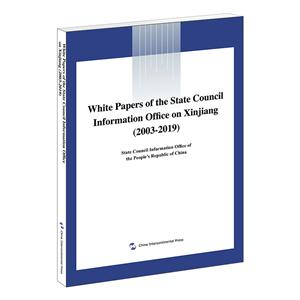
國務院新聞辦公室涉疆白皮書匯編(2003-2019)(英) 版權信息
- ISBN:9787508545035
- 條形碼:9787508545035 ; 978-7-5085-4503-5
- 裝幀:一般膠版紙
- 冊數:暫無
- 重量:暫無
- 所屬分類:>
國務院新聞辦公室涉疆白皮書匯編(2003-2019)(英) 本書特色
本書內容涉及新疆的歷史、宗教、文化、民族發展及社會經濟等各方面,是了解新疆發展與人權進步的重要窗口,回應了國際社會對新疆事務的關切。
國務院新聞辦公室涉疆白皮書匯編(2003-2019)(英) 內容簡介
新疆是中國神圣領土不可分割的一部分。然而,一段時間以來,中國新疆地區深受民族分裂勢力、宗教特別勢力、暴力恐怖勢力的疊加影響,恐怖襲擊事件頻繁發生,對各族人民生命財產安全造成極大危害,嚴重踐踏了人類尊嚴。西方一些人則極力炒作新疆問題,對中國進行抹黑、施壓,妄圖以此增加對華博弈的籌碼。《國務院新聞辦公室涉疆白皮書匯編》匯集了國務院新聞辦公室自2003年以來發表的涉疆白皮書,包括《新疆的歷史與發展》《新疆的發展與進步》《新疆生產建設兵團的歷史與發展》《新疆各民族平等團結發展的歷史見證》《新疆的宗教信仰自由狀況》《新疆人權事業的發展進步》《新疆的文化保護與發展》《新疆的反恐、去特別化斗爭與人權保障》《新疆的若干歷史問題》《新疆的職業技能教育培訓工作》10本白皮書,系統地介紹了新疆的歷史、宗教、文化和民族等發展情況,體現了新中國成立以來新疆各方面取得的發展進步。本書對于靠前外人士了解新疆發展及人權進步具有重要意義,既是對靠前社會對新疆事務關切的回應,也是對境外敵對勢力蓄意歪曲歷史、混淆是非的有利反擊。
國務院新聞辦公室涉疆白皮書匯編(2003-2019)(英) 目錄
History and Development of Xinjiang (May 2003) ........................................................ 1
Development and Progress in Xinjiang (September 2009) ........................................... 39
The History and Development of the Xinjiang Production and
Construction Corps (October 2014) ............................................................................. 75
Historical Witness to Ethnic Equality, Unity and Development in Xinjiang
(September 2015) ......................................................................................................... 88
Freedom of Religious Belief in Xinjiang (June 2016) ................................................ 127
Human Rights in Xinjiang – Development and Progress (June 2017) ...................... 141
Cultural Protection and Development in Xinjiang (November 2018) .......................... 161
The Fight Against Terrorism and Extremism and Human Rights
Protection in Xinjiang (March 2019) .......................................................................... 177
Historical Matters Concerning Xinjiang (July 2019) .................................................. 200
Vocational Education and Training in Xinjiang (August 2019) ................................... 217
Development and Progress in Xinjiang (September 2009) ........................................... 39
The History and Development of the Xinjiang Production and
Construction Corps (October 2014) ............................................................................. 75
Historical Witness to Ethnic Equality, Unity and Development in Xinjiang
(September 2015) ......................................................................................................... 88
Freedom of Religious Belief in Xinjiang (June 2016) ................................................ 127
Human Rights in Xinjiang – Development and Progress (June 2017) ...................... 141
Cultural Protection and Development in Xinjiang (November 2018) .......................... 161
The Fight Against Terrorism and Extremism and Human Rights
Protection in Xinjiang (March 2019) .......................................................................... 177
Historical Matters Concerning Xinjiang (July 2019) .................................................. 200
Vocational Education and Training in Xinjiang (August 2019) ................................... 217
展開全部
國務院新聞辦公室涉疆白皮書匯編(2003-2019)(英) 節選
History and Development of Xinjiang The State Council Information Office of the People’s Republic of China May 2003 Foreword The Xinjiang Uygur Autonomous Region (also called Xinjiang for short), situated in the border area of northwest China and the hinterland of the Eurasian Continent, occupies an area of 1.6649 million sq km, accounting for one sixth of Chinese territory. It has a land border of 5,600 km bounded by eight countries. It was an important section of the ancient Silk Road. According to statistics, in the year 2000 Xinjiang had a population of 19.25 million, including 10.9696 million people of other ethnic groups than the Han, China’s majority ethnic group. There are 47 ethnic groups in Xinjiang, mainly the Uygur, Han, Kazak, Hui, Mongolian, Kirgiz, Xibe, Tajik, Ozbek, Manchu, Daur, Tatar and Russian. It is one of China’s five autonomous regions for ethnic minorities. Since ancient times, Xinjiang has been inhabited by many ethnic groups believing in a number of religions. Since the Western Han Dynasty (206 B.C.-24 A.D.), it has been an inseparable part of the unitary multi-ethnic Chinese nation. In the more than 50 years since the People’s Republic of China was founded, the people of all ethnic groups in Xinjiang, with concerted and pioneering efforts, have jointly written brilliant pages in the annals of its development, construction and frontier defense, causing earth-shaking changes in the social outlook of the region. I. Xinjiang Has Been a Multi-ethnic Region Since Ancient Times In ancient history, many tribes and ethnic groups lived in Xinjiang. The ethnic origins of the residents of Xinjiang began to be clearly recorded in the Han Dynasty (206 B.C.-220 A.D.), the main ones being the Sai (Sak), Rouzhi (or Yueh-chih), Wusun (Usun), Qiang, Xiongnu (Hun) and Han. The Sai as a nomadic tribe used to roam about the area from the Ili and Chuhe river basins in the east to the Sir (Syrdarya) River valley in the west. Under pressure from the Rouzhi, they moved westward – some to the north bank of the Sir River, while others southward to scatter in the areas of the Pamirs. The Rouzhi roamed the vast region between the Gansu Corridor and the Tarim Basin during the Warring States Period (475 B.C.-221 B.C.) and flourished during the Qin (221B.C.-206 B.C.) and Han dynasties. Attacked by the Xiongnu around 176 B.C., they were forced to move to the Ili River basin, from which they dislodged the Sai. The Wusun first lived in the Gansu Corridor. In the late Qin and early Han period, attacked by the Rouzhi they yielded their allegiance to the Xiongnu. Supported by the Xiongnu, the Wusun attacked the Rouzhi, and drove them out of the Ili River basin. The Qiang originally lived along the middle and upper reaches of the Yellow River. During the Spring and Autumn (770 B.C.-476 B.C.) and Warring States periods, some of the Qiang migrated westward across the Gansu Corridor and the Qilian-Kunlun mountain ranges, leaving their footprints in Xinjiang. The Xiongnu entered Xinjiang mainly around 176 B.C. The Han was one of the earliest peoples to settle in Xinjiang. In 101 B.C., the Han empire began to station garrison troops to open up wasteland for cultivation of farm crops in Luntai (Bügür), Quli and some other places. Later, it sent troops to all other parts of Xinjiang for the same purpose. All the garrison reclamation points became the early settlements of the Han people after they entered Xinjiang. Since the Western Regions Frontier Command was established in 60 B.C., the inflow of the Han people to Xinjiang, including officials, soldiers and merchants, had never stopped. The period of the Wei, Jin and Southern and Northern Dynasties (220 A.D.-589 A.D.) was a period of the large-scale merging of ethnic groups in China, witnessing frequent ethnic migration across the land of China, and the entry into Xinjiang by many ancient ethnic groups, such as the Rouran (Jorjan), Gaoche, Yeda and Tuyuhun. The Rouran were descendants of the Donghu, an ancient people rising on the northern grasslands in the early fifth century. After establishing a powerful regime on the Mongolian grasslands in 402 A.D., they struggled with the Northern Wei (386-534) for domination of the Western Regions. The nomadic Gaoche, also called the Tolos or Teli, first appeared around Lake Baikal and the basins of the Orkhon and Tura rivers. In 487, Avochilo, chief of the Puwurgur tribe of the Gaoche, and his brother Qunqi led more than 100,000 families to migrate westward, and founded the state of Gaoche to the northwest of Anterior Cheshi (the ancient city of Jiaohe near modern Turpan). The Yeda, rising in the region north of the Great Wall, moved eastward to the Tarim Basin, attacked the Rouzhi in the south and set up a state in the late fifth century. They crossed the Pamirs, and once controlled part of southern Xinjiang. The Tuyuhun, originating from the ancient Xianbei people, moved westward from Liaodong (the region east of the Liaohe River in northeast China) in the early fourth century, and set up their own regime after conquering the ancient Di and Qiang peoples in the region of southern Gansu, Sichuan and Qinghai. In the Sui (581-618) and Tang (618-907) dynasties, the ancient Turk and Tubo peoples exerted important influences on the course of Xinjiang’s history. The Turks were ancient nomads active on the northwestern and northern grasslands of China from the sixth to the eighth centuries. Tümaen, a Turki leader, defeated the Rouran in 552, and set up a state centered in Mobei (the area north of the vast deserts on the Mongolian Plateau). The Turki realm later split into the eastern and western sides which fought ceaselessly in their scramble for the khanate. In the middle of the eighth century, both the Eastern and Western Turki khanates disappeared, their descendants being assimilated by other ethnic groups. The Tubo were the ancestors of the Tibetans, rising to notice on the Qinghai-Tibet Plateau in the late sixth century. After occupying Qinghai, they began to vie with the Tang Dynasty for control of the Western Regions. In 755, An Lushan and Shi Siming raised a rebellion in the Central Plains, and Tang troops stationed in the Western Regions were withdrawn to battle the rebels, whereupon the Tubo took the opportunity to occupy southern Xinjiang and part of northern Xinjiang. In 840, large numbers of Uighurs (an ancient name for modern Uygurs) entered Xinjiang. The Uighur, originally called Ouigour, sprang from the ancient tribe Teli. They were first active in the Selenga and Orkhon river basins, and later moved to the north of the Tura River. In 744, the Uighur founded a khanate in Mobei, and later dispatched troops twice to help the Tang central authorities to quell the An Lushan-Shi Siming Rebellion. The Uighur Khanate collapsed in 840 because of natural disasters, internal strife and attacks by the ancient Jiegasi tribe. Consequently, most of the Uighur migrated westward. One of their sub-groups moved to the modern Jimsar and Turpan regions, where they founded the Gaochang Uighur Kingdom. Another sub-group moved to the Central Asian grasslands, scattered in areas from Central Asia to Kashi, and joined the Karluk and Yagma peoples in founding the Karahan Kingdom. After that, the Tarim Basin and its surrounding areas were under the rule of the Gaochang Uighur Kingdom and the Karahan Kingdom. The local residents were merged with the Uighurs that had moved west, thus laying the foundation for the subsequent formation of the Uygur ethnic group. In 1124, Yollig Taxin, a member of the ruling house of the Liao Dynasty (916-1125), led his people, the Khitan tribe, westward and conquered Xinjiang, where he established the kingdom of Western Liao. In the early 13th century, Genghis Khan led an expeditionary army to Xinjiang, where he granted the territories he had conquered to his children and grandchildren. The Uighurs further assimilated a portion of the Khitans and Mongolians. Oyrat was the general name used for the Mongolians in Moxi (the area west of the vast deserts on the Mongolian Plateau) in the Ming Dynasty (1368-1644). The Oyrat first lived in scattered areas along the upper reaches of the Yenisaey River, gradually spreading to the middle reaches of the Ertix and Ili river basins. The early 17th century saw the rise among them of the Junggar, Dorbüt, Huxut and Turgut tribes. In the 1670s, the Junggar occupied the Ili River basin, becoming leader of the four tribes, and put southern Xinjiang under their control. From the 1760s on, the government of the Qing Dynasty (1644-1911) sent Manchu, Xibe and Suolun (Daur) troops from northeast China to Xinjiang in order to strengthen the frontier defense of the region, and they added to the ethnic mix in Xinjiang. Afterwards, Russians and Tatars migrated into Xinjiang. By the end of the 19th century, Xinjiang had 13 ethnic groups, namely, Uygur, Han, Kazak, Mongolian, Hui, Kirgiz, Manchu, Xibe, Tajik, Daur, Ozbek, Tatar and Russian. The Uygurs formed the majority, as they do today.
國務院新聞辦公室涉疆白皮書匯編(2003-2019)(英) 作者簡介
國務院新聞辦公室組建于1991年1月,主要職責是推動中國媒體向世界說明中國,包括介紹中國的內外方針政策、經濟社會發展情況,及中國的歷史和中國科技、教育、文化等發展情況。通過指導協調媒體對外報道,召開新聞發布會,提供書籍資料及影視制品等方式對外介紹中國。
書友推薦
- >
自卑與超越

- >
有舍有得是人生
- >
推拿
- >
詩經-先民的歌唱
- >
羅曼·羅蘭讀書隨筆-精裝
- >
山海經
- >
上帝之肋:男人的真實旅程
- >
李白與唐代文化
本類暢銷